Geomagnetic storm update - 15th December 2025
What Has Happened?
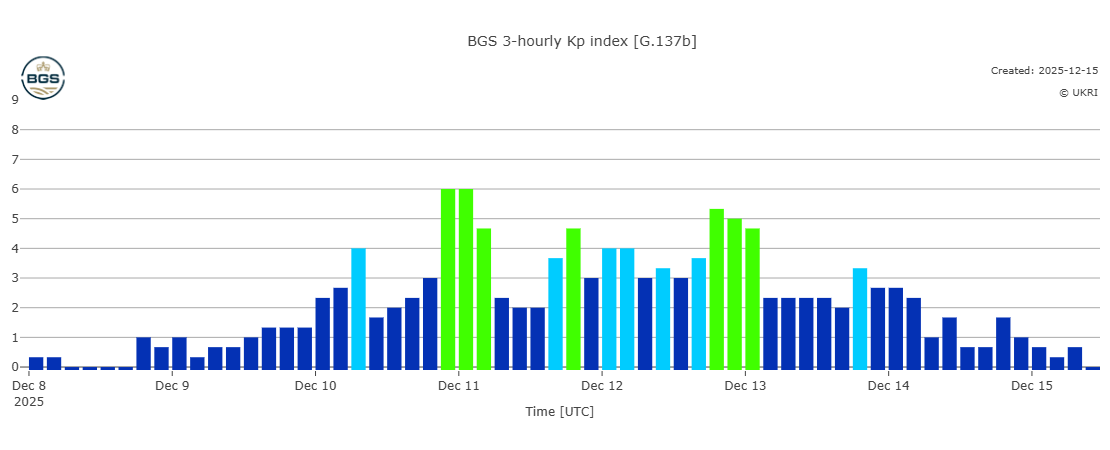
The coronal mass ejection (CME) associated with an M-class solar flare from the 6th of December arrived much later than expected, in the evening hours on the 10th of December, and caused less severe impact than originally predicted.
A combination of several further CMEs that left the Sun on the 8th and 9th of December seems to have given the Earth a glancing blow on the 11th of December, resulting in additional periods of elevated geomagnetic activity. A coronal hole high-speed stream that followed kept the conditions at ACTIVE and STORM levels throughout the 12th and 13th of December.
Sign-up to receive Geomagnetic Storm Forecast emails.
Follow us on Twitter:
Follow @BGSauroraAlert for more occasional aurora alerts.
Follow @BGSspaceWeather for daily space weather forecasts.
Glossary
- BGS
- The British Geological Survey is a geoscience research centre that is part of UK Research and Innovation (UKRI) and affiliated to the Natural Environment Research Council (NERC).
- CME or Coronal Mass Ejection
- The eruption of a portion of the outer atmosphere of the Sun into space, caused by rapid changes in its magnetic field. Often occurs along with a solar flare.
- Solar Flare
- Energy released by the explosive reorganisation of magnetic fields within the Sun's atmosphere.
- Coronal Hole
- A region in the Sun’s outer atmosphere (corona) where hot material can flow unrestrained by its magnetic fields out into space.
- High Speed Stream
- A fast moving stream of solar wind, responsible for magnetic storms.